
DEAR READER: Please consider a basic support membership at $5 per month, a like and a repost helps too. As a journalist in Ukraine, I work every day to examine our world situation from where the fulcrum of the world’s hell pivots, and your help is vital. Independent Journalism is not cheap to do, and I will keep making the posts available for all readers (even during nearly 24 hr daily blackouts), but good patrons are needed and I thank you for your time. – Chris Sampson, Kyiv, January 30, 2026
I have been in Ukraine for four years as of today, and this is my fourth winter. I saw the systems attacked in 2022, 2023, 2024, 2025 and now 2026. I started my first writing on this angle however in 2016 when I documented the December 2015 cyber attack on the grid, and my first chapter writing in early winter 2022. Now, we are at far worse situation with elders freezing in buildings and an unfolding humanitarian crisis. Most days are spent in total blackout. It is vital to understand this is Russia’s weaponization of winter and not new for the genocidal regime.
When Oleksandr Kharchenko stood before journalists at Media Center Ukraine on Wednesday, he chose his words carefully. The director of the Energy Research Center had spent the previous weeks watching Kyiv’s electricity grid buckle under conditions he described as “the most difficult period” since Russia’s full-scale invasion began nearly four years ago. But his message wasn’t about the cold, or the darkness, or the 16-hour daily blackouts that had become routine for millions of Ukrainians.
It was about the future being built in the rubble.
“The main help the Western world can provide to Ukraine’s energy sector right now is private investment,” Kharchenko said, responding to a question about American support. “But in wartime, private investment needs political insurance and guarantees from governments or international institutions—such as the European Union, the U.S. government, or the World Bank Group—that these investments will be protected.”
The statement, delivered in measured English to a room of Ukrainian and foreign correspondents, contained within it the entire strategic challenge facing Ukraine as it enters its fifth winter under sustained Russian attack on civilian infrastructure. Because what’s happening in Kyiv isn’t just about keeping the lights on through February. It’s about whether Ukraine will emerge from this war with the institutional capacity to function as a modern state—or whether Russia’s methodical destruction of power plants, transmission lines, and municipal heating systems will accomplish through infrastructure collapse what its ground forces have failed to achieve through territorial conquest.
This is the story of how systematic targeting of civilian energy infrastructure serves as a tool of occupation—and what Ukraine’s response reveals about the real nature of this war.
I. The Architecture of Collapse
The numbers tell the first part of the story.
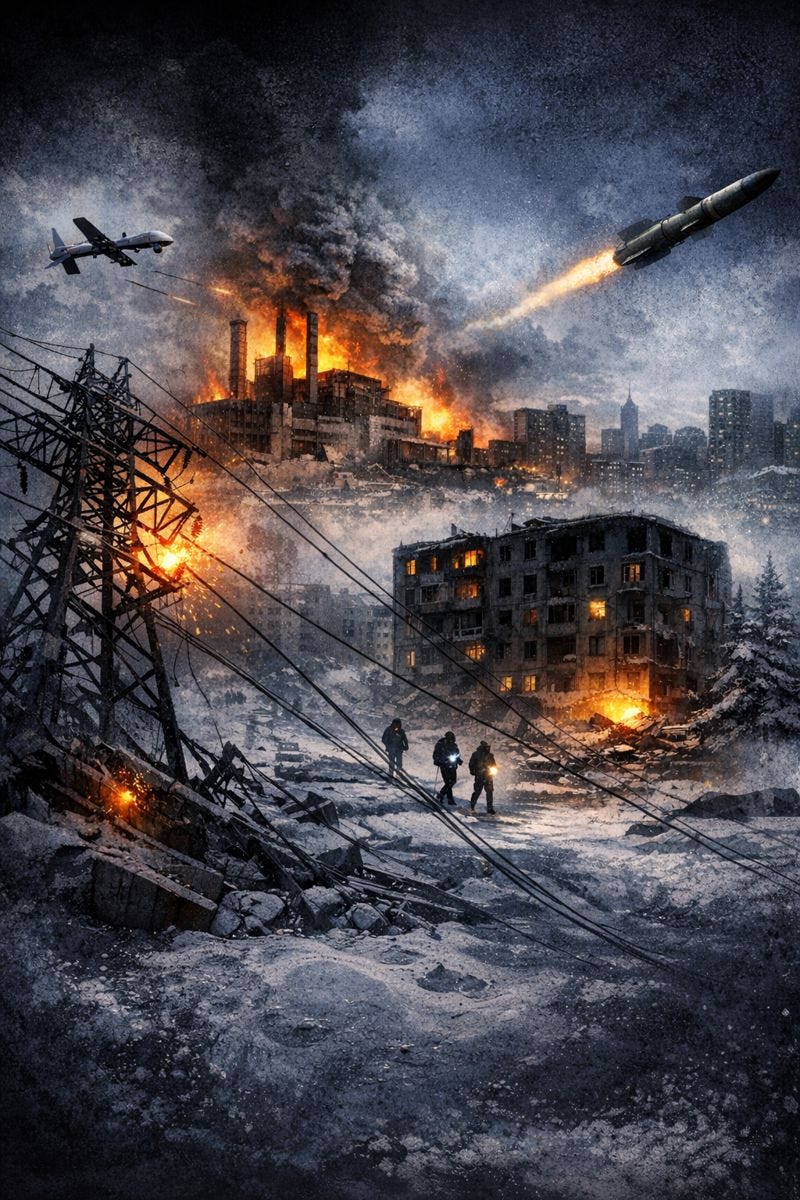
Since September 11, 2022, when Russian missiles first struck the Kharkiv TEC-5 power plant, Russia has conducted at least 48 documented major attacks specifically targeting Ukraine’s energy infrastructure. The pattern escalated dramatically in late 2024 and has continued with increasing intensity into 2026:
-
December 13, 2024: 94 missiles and 193 UAVs in one of the largest coordinated strikes
-
December 25, 2024: Over 70 missiles and 100 drones on Christmas Day
-
January 9, 2026: 242 drones and 36 missiles knocked out electricity across 70% of Kyiv, leaving 6,000 buildings without heat
-
January 20, 2026: 339 drones and 34 rockets disabled heating to 5,600 buildings in Kyiv
-
January 23, 2026: 375 drones and 21 missiles left over 800,000 subscribers without power
-
January 24, 2026: Vast combined attack left 1.2 million properties without power nationwide
The cumulative effect has been catastrophic. According to Kharchenko’s briefing, Kyiv—a city that once had 1.2 gigawatts of local electricity generation—now has effectively zero generation capacity within city limits. The combined heat-and-power plants that once served as the backbone of both the electrical grid and the municipal heating system have been systematically destroyed or disabled.
“Supplying Kyiv entirely from outside the city is a complex technical task even in peacetime,” Kharchenko explained. “Under constant strikes and ongoing damage to the grid, it creates an entirely different reality.”
The current reality: Kyiv can receive approximately 650-700 megawatts of electricity through transmission lines from outside the city. Total demand in freezing weather runs around 1.5 gigawatts—roughly double available capacity. When temperatures drop further, demand climbs to 1.8-2 gigawatts.
The mathematics of this gap are simple. The implications are profound.
II. The Precedent: How Infrastructure Destruction Enables Occupation
What’s happening in Ukraine follows a pattern established across multiple Russian military operations over the past three decades. The destruction of civilian infrastructure isn’t collateral damage—it’s a strategic instrument designed to create dependency, enable administrative capture, and ultimately facilitate permanent occupation.
Chechnya, 1999-2009: Russian forces systematically destroyed Grozny’s power plants, water treatment facilities, and heating systems. The reconstruction that followed was managed entirely by Moscow-appointed authorities, creating economic dependency that reinforced political control. Chechen civilians who wanted heat, electricity, or running water had to interface with Russian administrative structures. The infrastructure itself became a tool of pacification.
Georgia, 2008: Russian forces didn’t just occupy South Ossetia and Abkhazia—they systematically destroyed the transmission lines that connected these regions to the Georgian national grid. Post-conflict “stabilization” required these territories to integrate with Russian energy systems. What began as military necessity became permanent economic reorientation.
Crimea, 2014: Within weeks of annexation, Russia began constructing the Kerch Strait energy bridge, not because Crimea lacked connection to Ukrainian power (it didn’t), but because energy dependency needed to be redirected. Ukrainian power lines were severed. Russian infrastructure replaced them. The physical architecture of sovereignty was literally rewired.
Eastern Ukraine, 2014-2022: In occupied Donetsk and Luhansk, the pattern was identical. Destroy Ukrainian infrastructure. Provide Russian alternatives. Create populations that quite literally cannot function without Russian systems. When people ask “how do you hold occupied territory?” this is part of the answer: you make it physically impossible for daily life to continue without the occupier’s administrative and technical systems.
The current campaign against Ukraine’s energy infrastructure at scale represents the industrialization of this strategy. Russia isn’t trying to defeat Ukraine’s military through infrastructure collapse—Ukrainian forces have proven remarkably resilient even under blackout conditions. Russia is trying to make Ukrainian cities ungovernable by Ukrainian authorities.
III. The Kyiv Case Study: Anatomy of Systematic Destruction
Kharchenko’s briefing provided the most detailed public accounting to date of what Russia’s campaign has accomplished in Ukraine’s capital. The granular details reveal the sophistication of the targeting.
Kyiv’s energy system was designed around a hub-and-spoke model. Four combined heat-and-power plants (CHPs) located within or near the city served dual functions: they generated electricity and produced hot water for municipal heating systems. These plants weren’t just power stations—they were the structural nodes that made the entire grid function.
When Russian strikes disabled these facilities between 2022 and 2026, they didn’t just eliminate 1.2 gigawatts of generating capacity. They eliminated the anchor points that stabilized the entire distribution network. The grid was designed to push power outward from these plants. Now it has to pull power inward from distant facilities through transmission lines that were never intended to carry such loads.
The result, as Kharchenko described it, is a complete reconfiguration of how electricity reaches the city: “DTEK Kyiv Energo, Ukrenergo, and Kyivteploenergo are all working together on this—to increase the amount of power that can be transmitted into Kyiv, and to improve how it is distributed within the city. Even if electricity reaches Kyiv, many districts currently cannot accept it because their internal networks don’t have enough capacity to distribute it locally.”
Translation: The physical infrastructure of the city—transformers, substations, distribution lines at the neighborhood level—was never built to function this way. Engineers are essentially rebuilding the electrical nervous system of a city of 3 million people while that city is under active bombardment.
The heating system faces even more dire constraints. Kharchenko expressed cautious optimism that buildings currently without heat would be reconnected “no later than the end of the first ten days of February,” but acknowledged the work is being done “literally from fragments.” Boilers and auxiliary equipment are “in extremely poor condition.” Even after heating capacity is restored, there’s the separate challenge of reconnecting buildings whose internal systems have been damaged by frozen pipes, drained water, and months of disuse.
“These are old buildings with aging systems that haven’t been properly maintained for years,” Kharchenko noted. “The consequences of that, unfortunately, we are already seeing—and will continue to see.”
This is what infrastructure collapse looks like at the municipal level: even after you restore the primary systems, the secondary and tertiary failures cascade through every building, every neighborhood, every district. It’s not one problem to fix. It’s thousands of problems, each requiring individual assessment and repair, all while trying to keep people from freezing to death.
IV. The Donor Dilemma: Why Emergency Aid Fails Strategic Challenges
The international response to Ukraine’s energy crisis has been substantial in humanitarian terms—generators, transformers, emergency equipment shipments from dozens of countries. Kharchenko acknowledged these efforts but was blunt about their limitations.
“To be honest, I’m fairly skeptical, for two main reasons,” he said. “First, there have been many announcements about sending generators and other equipment. This can help locally—when and if it arrives—and I hope at least part of it arrives before the end of this cold spell. But it only helps in specific places. It’s not a magic solution. It provides some relief and additional ‘Points of Resilience,’ but it does not fundamentally solve the problem.”
The second reason cut deeper: “Our partners often genuinely don’t understand what is needed. They need a very clear, focused request from the Ukrainian side—specifying exactly what is needed and how it should be delivered.”
This gets to the structural dysfunction at the heart of Ukraine’s energy crisis response. The standard mechanisms for international assistance—like the Energy Support Fund under the Energy Community—operate on timelines measured in years. Contracts take twelve months to finalize. Equipment must then be manufactured and delivered. For a country facing systematic destruction of infrastructure during active combat, these timelines are functionally useless.
“We simply do not have that kind of time right now,” Kharchenko said. “We need faster pathways.”
He pointed to mechanisms that worked until September 2024 through Ukrenergo, Ukraine’s transmission system operator. But restoring those channels requires addressing fundamental governance problems that have paralyzed institutional reform: “Many international partners understand this model, but it requires the Ukrainian side to make a series of decisions—including in the area of corporate governance: restoring supervisory boards, revising charters that were changed in ways Europeans consider problematic, and rebuilding institutional trust.”
The governance crisis became public in late 2024 when Ukraine dismissed the supervisory boards of multiple state energy companies. The stated reason was wartime necessity and the need for direct government control. The practical effect was to sever the institutional relationships with European partners that had enabled rapid equipment procurement and technical assistance.
Western donors aren’t going to write blank checks to state companies with no independent oversight. European energy firms aren’t going to engage in joint projects with entities whose corporate governance doesn’t meet basic transparency standards. The Ukrainians know this. The Europeans know this. And yet, as of January 29, 2026, the fundamental governance reforms remain incomplete.
Kharchenko noted that Energoatom, the nuclear power operator, had finally appointed a new supervisory board—four independent members, three state representatives. But he couldn’t hide his frustration at the delay: “On one hand, it’s positive. But why did it take so long? The appointment of independent board members was announced weeks ago. We were told the selection was complete. But there was no formal order of appointment. And as far as I know, their contracts still haven’t been signed.”
For the other major energy companies—Ukrenergo, the gas transmission operator, municipal heating utilities—the situation remains unresolved. “Changes to the charters of key companies have not yet been publicly confirmed. Many independent board members across the sector remain unappointed,” Kharchenko said.
This isn’t just bureaucratic dysfunction. It’s a strategic vulnerability. Every week without proper governance structures is a week when Ukraine cannot access the financing mechanisms, technical partnerships, and equipment supply chains it needs to rebuild. Russia doesn’t have to destroy every power plant if Ukraine’s own institutional paralysis prevents reconstruction.
V. The Coordination Vacuum: When Cities Can’t Plan and Donors Can’t Target
The governance crisis feeds directly into what Kharchenko identified as the most critical systemic failure: the absence of coordinated planning between municipal utilities, national energy companies, and international partners.
“The final and critical point is the lack of effective coordination today between municipal utilities, national energy companies, and international partners,” he said. “Historically, municipal heat utilities—for example, Teplokomunenergo—do not report to the Ministry of Energy. There is a long-standing perception that they are largely separate from the Ministry.”
This administrative fragmentation might be manageable in peacetime. Under bombardment, it’s catastrophic.
Kyiv’s municipal heating system is managed separately from the national electricity grid, which is managed separately from the gas transmission network, which is managed separately from the nuclear power plants. When Russian missiles destroy a combined heat-and-power plant in Kyiv, who coordinates the response? Who determines whether to prioritize restoring electricity generation or heating capacity? Who decides which districts get reconnected first? Who interfaces with international donors to specify what equipment is needed and where it should be delivered?
The answer, as of late January 2026, appears to be: no one, systematically.
Kharchenko’s prescription was stark: “Real coordination is essential—not just creating a ‘task force,’ but building a system of clear, prioritized requests to donors: what is needed, in what quantities, what equipment, how it will be delivered, and who can supply it.”
He argued that every major entity needs a comprehensive reconstruction plan:
“Kyiv needs such a plan. Odesa needs such a plan. Dnipro needs such a plan. Ukrenergo needs such a plan. DTEK, as a private company, is doing this quite effectively. Centrenergo needs such a plan. Ukrhydroenergo needs such a plan. Each one should be able to say: ‘This is what we will do. This is what we need to do it. And this is how we will be prepared for next winter.’”
The plans would then need to be “coordinated by the Ministry of Energy, turned into structured donor requests, and clearly prioritized: this is priority number one. If we secure this, then we move to priority number two, then number three.”
The absence of such planning has direct consequences for what Ukraine can accomplish before winter 2026-2027. “With what we have now, we will get through to spring,” Kharchenko said. “In spring, things will ease somewhat—warmer temperatures, lower consumption, more solar generation, and increased hydro output will help. But if we don’t restore networks, generation, heating systems, and the infrastructure that supports them, next winter will not be better—even if there are no attacks.”
Then he added the assessment that should terrify Western policymakers: “And I am personally convinced that attacks will continue.”
VI. The Private Investment Trap: Guarantees in a War Zone
This brings us back to Kharchenko’s response about American support, which reframes the entire challenge.
Emergency generators are stopgaps. Government-to-government aid moves too slowly. Standard international assistance mechanisms can’t operate at the necessary speed. So what’s left?
Private investment—but only if Western governments provide the political risk insurance and guarantees that make such investment viable during active combat.
“With that kind of support, private investment can become the most efficient tool to restore, rebuild, modernize, and future-proof Ukraine’s energy system,” Kharchenko argued.
The logic is straightforward: private companies can move faster than governments, can deploy capital at scale, can bring technical expertise and management capacity that Ukrainian state companies currently lack. But no private investor is going to put money into infrastructure that could be destroyed by a Russian missile strike next week—unless someone credible guarantees that investment will be protected or compensated.
This is where Western governments come in. The European Union, the U.S. government, the World Bank Group, multilateral development banks—these institutions can provide political risk insurance, investment guarantees, and institutional backing that transforms the risk calculation for private capital.
There are precedents. Post-conflict reconstruction in the Balkans utilized exactly these mechanisms. The European Bank for Reconstruction and Development has instruments designed for exactly this scenario. The U.S. Development Finance Corporation exists specifically to mobilize private investment in challenging environments through guarantees and insurance.
The question is whether Western governments are prepared to deploy these tools at the scale required—and whether they’re willing to do so while Ukraine is still under active bombardment, not just after some future peace agreement.
Because here’s the strategic trap: if the West waits for a peace settlement to begin serious reconstruction investment, Russia’s infrastructure destruction campaign will have already accomplished its goal. Ukrainian cities will have spent years operating under improvised, degraded conditions. Populations will have adapted to life without reliable power, heat, or water. The institutional capacity to manage complex modern infrastructure will have atrophied. The technical workforce will have emigrated. The supply chains will have collapsed.
By the time peace comes, Ukraine might be technically sovereign but functionally ungovernable—at least not without massive external support that creates its own form of dependency.
This is the endgame Russia is pursuing. Not outright annexation of all Ukrainian territory (though they’ll take what they can get), but the creation of a dysfunctional state that cannot provide basic services to its population, cannot integrate with European systems, cannot sustain economic development, and ultimately cannot resist Russian pressure for “special arrangements” that amount to de facto control.
Infrastructure destruction isn’t a war crime and nothing more. It’s a tool of strategic subjugation. And it’s working.
VII. The Regional Asymmetry: Why Western Ukraine Has Power While Kyiv Goes Dark
One of the most politically sensitive revelations in Kharchenko’s briefing concerned the vast disparities in how different regions are experiencing the energy crisis.
“There are large cities where there are effectively no outages, simply because electricity cannot physically be transmitted to Kyiv or Odesa,” he explained. “There are no available pathways to move that power. So what should be done—shut off Lviv artificially? I’m speaking hypothetically, but you understand the logic.”
The implication is explosive: some Ukrainian cities have stable power not because their infrastructure is intact, but because the transmission grid cannot physically move their electricity to the heavily bombarded eastern and central regions that desperately need it.
This creates a perverse political dynamic. Residents of western Ukrainian cities might experience minimal disruptions while Kyiv residents endure 16-hour daily blackouts. The suffering is not evenly distributed. The war’s impact is radically unequal across the country’s geography.
Kharchenko identified four major urban agglomerations under constant attack: “Kyiv, Odesa, Dnipro–Kryvyi Rih, and Kharkiv. In all four, the situation is broadly similar—meaning very difficult.”
For the rest of the country: “Outside the heavily targeted regions, the situation is significantly better.”
But even in relatively stable western regions, vulnerability remains: “There are problem areas too—especially in regions dependent on nuclear power plants. If something happens with a plant’s output, they can face three or four very difficult days, with electricity unavailable for half a day or more. Then the system stabilizes again.”
The regional disparities raise uncomfortable questions about national cohesion, resource allocation, and political sustainability. How long can Kyiv ask western Ukrainian cities to accept restrictions they don’t need in order to share power with the capital? How do you maintain national solidarity when the war’s hardships fall overwhelmingly on specific regions? How do you prevent the emergence of resentment between Ukrainians who are suffering acute deprivation and those who are not?
Russia understands these dynamics. The targeting isn’t random. The goal is to create exactly this kind of internal political stress—to make the continuation of resistance more costly for some Ukrainians than for others, to fracture the national consensus that has sustained Ukraine’s defense.
VIII. The Import Question: Why European Electricity Can’t Save Kyiv
A common assumption among casual observers is that Ukraine can simply import more electricity from Europe to compensate for destroyed domestic generation. Kharchenko addressed this directly.
“Technically, on the European side, we have the maximum permitted level of imports, and in practice it is being used almost fully,” he said. Government decisions to shift major consumers like Naftogaz and Ukrzaliznytsia (Ukrainian Railways) to imported electricity have helped. “This significantly eases the situation in certain western regions. It does not help Kharkiv, Odesa, Kyiv, or, to a large extent, Kryvyi Rih. In those areas, the current situation does not change.”
The problem is physics, not policy. Electricity imports from Europe enter Ukraine through western border connections. The transmission lines that would be needed to move that power eastward to Kyiv, Kharkiv, or Odesa either don’t exist, have been destroyed, or lack sufficient capacity.
You can’t email electricity. It has to physically travel through wires, through transformers, through substations. If those pathways are damaged or insufficient, it doesn’t matter how much power is available at the border—it cannot reach the cities that need it.
This is why Kharchenko emphasized that one of the two major blocks of work needed to stabilize Kyiv involves “restoring high-voltage transmission lines so Kyiv can receive much more electricity than it can right now.”
Until those transmission corridors are rebuilt and reinforced, European imports will benefit western Ukraine but leave the most heavily targeted cities dependent on whatever domestic generation survives—which, in Kyiv’s case, is currently nothing.
IX. The Nuclear Question: Energoatom’s Uncertain Future
When asked about the condition of Ukraine’s nuclear power capacity, Kharchenko demurred: “Let’s wait for the supervisory board to begin its work and tell us what’s really happening with nuclear capacity. There are many questions, but I’m not ready to discuss them right now, because we simply do not have verified, objective information.”
The careful phrasing speaks volumes. Ukraine’s nuclear plants—currently operating reactors at Rivne, South Ukraine, and Khmelnytskyi—provide the backbone of the country’s surviving electricity generation. They have thus far proven relatively resilient to Russian attacks, though the occupied Zaporizhzhia Nuclear Power Plant remains a constant threat hanging over the entire system.
But Kharchenko’s reluctance to discuss nuclear capacity suggests serious concerns about either the operational status of the plants, their maintenance and safety conditions, or the governance and financial health of Energoatom itself.
Nuclear power plants are not simple generators you can turn on and off at will. They require constant maintenance, specialized parts, rigorous safety protocols, and highly trained personnel. Operating nuclear facilities under combat conditions, with degraded transmission networks, while facing systematic Russian attacks on all other parts of the grid, creates risks that are difficult to publicly articulate without causing panic.
The recent appointment of Energoatom’s supervisory board—delayed for weeks amid political controversy—suggests that serious problems exist that require outside oversight to address. Whether those problems are technical, financial, or administrative remains unclear. What’s certain is that Ukraine’s energy future depends heavily on these plants continuing to operate safely and reliably. Any significant disruption to nuclear generation would be catastrophic.
X. The Timeline Question: When Does This Get Better?
The most politically sensitive aspect of Kharchenko’s briefing was his timeline for improvement—or rather, the lack of one.
For heating restoration: “No later than the end of the first ten days of February” for buildings currently without heat, followed by the separate challenge of reconnecting them to functional systems.
For electricity in Kyiv: A return to “familiar queue-based” outage schedules “could be possible in two to three weeks,” but only “assuming effective air defense and a relatively stable trend.” Kyiv will be “operating under outage schedules for quite some time.”
For restoration of generation capacity in Kyiv: “Impossible” in the near term. “We’re talking about months.”
For preparation for next winter: Only possible if comprehensive planning begins now, coordination improves dramatically, governance reforms are completed, and international assistance mechanisms are rebuilt.
For the end of Russian attacks: “I am personally convinced that attacks will continue.”
Translation: There is no light at the end of this tunnel. The best-case scenario is managed degradation—keeping enough systems operational to prevent complete collapse while slowly, incrementally rebuilding under fire. The worst-case scenario is cascading failures that make major Ukrainian cities uninhabitable during winter months.
“With what we have now, we will get through to spring,” Kharchenko said. The confidence was limited to the immediate term. Beyond that: “If we don’t restore networks, generation, heating systems, and the infrastructure that supports them, next winter will not be better—even if there are no attacks.”
XI. The Pattern: What This Reveals About Russian Strategy
Step back from the technical details and the larger pattern becomes clear.
Russia is not trying to win a conventional military victory in Ukraine—its ground forces have proven incapable of that. Russia is trying to make Ukraine ungovernable, beginning with its cities.
The method: systematic destruction of the infrastructure that makes modern urban life possible—electricity, heating, water, sanitation, communications. Create conditions where Ukrainian authorities cannot provide basic services to their populations. Force millions of people to endure medieval living conditions in the ruins of what were once European cities.
The timeline: long enough that populations adapt to degraded conditions, institutional capacity atrophies, technical expertise emigrates, and the social compact between citizens and government fractures under the strain of persistent failure to deliver basic necessities.
The endgame: Ukraine emerges from the war technically sovereign but functionally dependent—either on Russia (the nightmare scenario) or on Western donors (the only slightly better scenario). Either way, Ukrainian agency is constrained. Either way, the state cannot independently provide for its population. Either way, someone else holds the keys to whether Ukrainian cities have heat in winter.
This is occupation strategy for the 21st century. You don’t need to hold every kilometer of territory if you can make that territory uninhabitable or ungovernable. You don’t need to station troops in Kyiv if you can ensure Kyiv cannot function as a capital city capable of sustaining a modern state.
The precedents are clear. Grozny was systematically destroyed and then rebuilt as a Russian city under Russian administration with Russian money and Russian political control. The Chechen Republic that emerged was technically autonomous, functionally subjugated. The infrastructure itself—rebuilt with Russian funding, operated by Russian-trained personnel, dependent on Russian supply chains—became a tool of political control.
Crimea’s energy infrastructure was severed from Ukraine and reoriented to Russia, making the political reversal of annexation infinitely more complex. Even if Crimea were somehow returned to Ukrainian sovereignty, how would it be powered? The transmission lines no longer connect. The systems have been integrated. Reversal would require not just political change but physical reconstruction of energy linkages that have been deliberately destroyed.
Eastern Ukraine under occupation has seen the same pattern. Destroy Ukrainian infrastructure. Provide Russian alternatives. Make populations dependent on Russian systems for survival. Then watch as resistance becomes logistically implausible—because you cannot fight the entity that controls whether your children freeze to death.
Scale this strategy to all of Ukraine and you have the current campaign. Russia cannot conquer Ukraine militarily. But Russia can make large parts of Ukraine uninhabitable during winter. And if Ukraine cannot solve the governance crisis, cannot coordinate reconstruction planning, cannot access the financing and technical support needed for rapid rebuilding, then Russia wins by default.
Not through occupation, but through rendering occupation unnecessary.
XII. The Western Response: Emergency Thinking vs. Strategic Reality
The fundamental disconnect in Western support for Ukraine’s energy sector is this: the West is providing emergency assistance for a crisis it treats as temporary, while Russia is executing a long-term strategy to permanently degrade Ukrainian state capacity.
Generators, transformers, and equipment shipments address immediate needs. They keep some hospitals operating, some shelters heated, some critical infrastructure functional. This is not nothing. Thousands of lives have been saved by these interventions.
But emergency aid does not rebuild a national electricity grid. It does not restore municipal heating systems. It does not train the engineers needed to manage complex modern infrastructure. It does not create the institutional capacity for long-term maintenance and development. It does not address the governance problems that prevent Ukraine from absorbing larger-scale assistance. It does not build the economic foundations that would allow Ukraine to eventually self-finance its own reconstruction.
Emergency aid, by definition, is temporary. It sustains. It does not solve.
What Kharchenko described—private investment backed by political risk guarantees from Western governments—represents a fundamentally different approach. It’s not charity. It’s not crisis response. It’s long-term strategic investment in rebuilding Ukraine as a functional modern state capable of defending its sovereignty through institutional capacity, not just military force.
The challenge is political will. Providing generators is relatively easy—donor countries can point to tangible aid delivered, refugees helped, lives saved. Establishing political risk insurance mechanisms for private infrastructure investment requires complex institutional arrangements, long-term financial commitments, and acceptance of risk that extends beyond electoral cycles.
Moreover, such investment requires acknowledgment that this war will not end soon, that Ukraine’s infrastructure needs cannot wait for a peace settlement, and that reconstruction must happen under fire. Western governments have proven reluctant to make these admissions, both to their own populations and to Ukraine.
The result is a strategic mismatch. Russia attacks infrastructure as a tool of long-term subjugation. The West responds with short-term humanitarian aid. Russia plans for a multi-year campaign to make Ukrainian cities uninhabitable. The West plans for the next winter. Russia thinks in terms of permanently reordering the post-Soviet space. The West thinks in terms of the next aid package.
This asymmetry is not sustainable. Ukraine cannot win a war where the adversary is playing a long game and the allies are improvising season by season.
XIII. The Governance Crisis: Why Ukraine Must Fix This Internally
Here is the uncomfortable truth that Kharchenko approached but did not quite state directly: some of Ukraine’s most serious problems in energy sector reconstruction are self-inflicted.
The dismissal of independent supervisory boards from state energy companies in 2024 was not forced by Russia. The delays in appointing new boards were not caused by Western pressure. The lack of coordination between municipal utilities and the Ministry of Energy is not a product of wartime chaos—it predates the full-scale invasion by decades.
These are Ukrainian institutional failures. They reflect deeper problems in how the Ukrainian state relates to its own state-owned enterprises, how power is concentrated or diffused across government ministries and municipal authorities, how transparency and accountability function (or don’t) in the energy sector.
Western donors cannot fix these problems. They can provide incentives, they can set conditions for assistance, they can offer technical expertise in corporate governance reform. But ultimately, Ukraine must decide whether it wants to be a modern European state with the institutional capacity to manage critical infrastructure professionally—or whether it wants to preserve Soviet-era patronage networks, concentrated executive power, and opacity in state enterprise management.
The war has laid bare the costs of the latter approach. When donors cannot trust the governance of recipient institutions, aid slows. When corporate structures don’t meet international standards, investment stops. When different government entities cannot coordinate with each other, reconstruction becomes chaotic and inefficient. When transparency is lacking, corruption thrives even under bombardment.
Kharchenko’s frustration was palpable: “I understand the Ministry of Energy is undergoing internal restructuring and operating in crisis mode. But not finding 30 minutes a day to say, ‘We are working on corporate governance—here’s what we’re doing,’ is about priorities. And in my view, this is one of the highest priorities, because it directly affects international assistance.”
This is not just bureaucratic dysfunction. It’s strategic sabotage. Every day without proper governance structures is a day when Ukraine cannot access the resources it needs to rebuild. Russia doesn’t have to destroy every power plant if Ukraine’s own institutional failures prevent reconstruction.
The appointment of Energoatom’s supervisory board—finally—represents a step forward. But it took months of delay, public pressure, and evident frustration from international partners to achieve what should have been a straightforward administrative action. If this is the pace of reform for the most critical institutional changes, what hope is there for the broader systemic transformation needed?
Ukraine’s defenders often, rightfully, point out that this is a country defending itself against genocidal invasion while simultaneously trying to implement complex institutional reforms. The challenge is immense. The expectations may be unfair. But the consequences of failure are catastrophic.
Because the hard reality is this: if Ukraine cannot get its institutional house in order, Russia wins through infrastructure collapse what it could not achieve through military conquest. The sovereignty that Ukrainian soldiers are dying to defend will be meaningless if the state they’re defending cannot provide heat in winter or keep the lights on.
XIV. The Question No One Is Asking: What If This Is The New Normal?
Kharchenko said he is “personally convinced that attacks will continue.” Take that assessment seriously and a darker scenario emerges—one that neither Ukrainian authorities nor Western partners seem prepared to confront.
What if this is not a temporary crisis to be weathered until peace arrives? What if this is the new permanent condition of Ukrainian statehood—a country that must maintain critical infrastructure under persistent bombardment, indefinitely?
Ukraine has now been under systematic Russian attack on civilian infrastructure for over three years. The pattern has not diminished. The scale has increased. The sophistication of targeting has improved. Russia has demonstrated both the capability and the willingness to sustain this campaign across multiple winters, through multiple Ukrainian air defense improvements, despite international condemnation.
Why would this stop? Even if a ceasefire is eventually negotiated, what prevents Russia from resuming attacks whenever politically convenient? Even if a peace agreement is signed, how would it be enforced? Russia has violated every previous agreement regarding Ukraine—from the Budapest Memorandum to the Minsk Accords. What makes anyone think future agreements would be different?
The uncomfortable truth is that Ukraine may need to build a society that can function under persistent threat of infrastructure destruction. That means:
-
Distributed generation: Moving away from centralized power plants toward distributed renewable energy, microgrids, and localized generation that cannot be destroyed by single strikes
-
Redundancy: Building backup systems, alternate pathways, and resilient infrastructure designed to sustain damage and continue operating
-
Rapid repair capacity: Maintaining stockpiles of equipment, training crews for emergency response, developing protocols for quick restoration
-
Civil defense integration: Hardening critical facilities, building underground infrastructure, preparing populations for sustained disruptions
-
Economic adaptation: Developing industries and services that can operate through blackouts and shortages
This is not the Ukraine that fought for European integration and liberal democratic development. This is something different—a fortress state, a nation built for endurance under siege, a society organized around resistance as a permanent condition.
The psychological, political, and economic costs of such a transformation would be staggering. It would require sustained external support at levels far beyond current Western commitments. It would demand social cohesion that might fracture under years of hardship. It would reshape what it means to be Ukrainian in ways that might not be sustainable.
But consider the alternative. If Ukraine plans for peace that doesn’t come, if it builds infrastructure that Russia can destroy at will, if it organizes society around normalcy that proves impossible to maintain—then the slow collapse Kharchenko warned about becomes inevitable.
The West, too, must confront this scenario. If supporting Ukraine means not just arming its military but sustaining its civilian infrastructure under bombardment indefinitely, are Western publics prepared for that commitment? Are Western budgets? Are Western political systems capable of maintaining that level of support across multiple electoral cycles, economic downturns, and shifting geopolitical priorities?
These are not questions anyone wants to answer. But they may be the most important questions facing Ukraine and its partners in 2026.
XV. Conclusion: The Precedent Being Set
On January 29, 2026, in a modest briefing room at Media Center Ukraine, an energy expert explained in careful technical language how Russia is systematically destroying the infrastructure that makes Ukrainian cities habitable.
The story is not just about Kyiv’s blackouts or Kharkiv’s heating crisis or the millions of Ukrainians enduring another winter under bombardment. It’s about what this war is establishing as precedent—for Ukraine, for Europe, for the international order.
If systematic destruction of civilian infrastructure becomes an acceptable tool of interstate conflict—if attacking power plants and heating systems is treated as conventional military strategy rather than war crimes—then every city becomes a potential target. If states can wage war through infrastructure collapse, creating humanitarian disasters that force populations to submit without formal occupation, then the entire post-World War II framework for limiting war’s impact on civilians becomes meaningless.
If Ukraine cannot rebuild under fire because Western institutions are not designed to support reconstruction during active combat, then the lesson for future conflicts is clear: destroy infrastructure early, destroy it thoroughly, and wait for institutional paralysis to do the rest. No need for territorial conquest. No need for prolonged occupation. Just render territories ungovernable and watch as sovereignty collapses from within.
If Ukraine’s own governance failures prevent effective reconstruction even when Western support is available, then the lesson for weak states everywhere is equally clear: institutional capacity matters more than defensive alliances. You can have Western weapons, Western aid, even Western public support—but if you cannot coordinate your own government agencies, cannot maintain transparency in state enterprises, cannot provide basic services to your population, then external support cannot save you.
These are the precedents being established in real time, in Kyiv’s darkened apartments, in Kharkiv’s frozen buildings, in the gap between Oleksandr Kharchenko’s measured briefing and the strategic realities it revealed.
Russia is not just fighting to control Ukrainian territory. Russia is demonstrating how modern warfare can achieve occupation’s effects without occupation’s costs—how infrastructure destruction can accomplish what armies cannot, how long-term degradation can substitute for battlefield victory, how making territories ungovernable can replace making them surrender.
The West is not just failing to provide adequate support to Ukraine’s energy sector. The West is revealing the limits of its institutional capacity to respond to 21st-century strategic challenges—limits of bureaucratic agility, limits of political will, limits of sustained commitment, limits of imagination.
Ukraine is not just defending its cities against Russian missiles. Ukraine is fighting to prove that sovereignty means something, that borders matter, that states have the right to exist independently even when powerful neighbors disagree—and simultaneously fighting to prove that it deserves to exist, that it can govern itself effectively, that it can coordinate reconstruction, that it can maintain institutional capacity under fire.
All of this was contained in Wednesday’s briefing. The immediate question was about American support for Ukraine’s energy sector. The deeper question was about what kind of world we are building through our responses to this war.
Kharchenko’s answer was precise: “The main help the Western world can provide to Ukraine’s energy sector right now is private investment. But in wartime, private investment needs political insurance and guarantees from governments or international institutions.”
This is the ask. This is the test. This is the moment when Western governments must decide whether they are prepared to back Ukraine’s reconstruction with the kind of institutional commitment that makes private capital viable in a war zone—or whether they will continue providing emergency aid while Russia systematically dismantles the infrastructure of Ukrainian statehood.
The next Russian missile strike is probably already being prepared. The next wave of drones is likely being launched. The campaign will continue. The destruction will accumulate. The winter will persist.
The question is not whether Ukraine will face more attacks. The question is whether, when spring finally comes, Ukraine will have built the institutional, technical, and financial foundations to face next winter—and the winter after that, and the winter after that—until Russia finally understands that infrastructure destruction cannot achieve what battlefield victory could not.
That is the real war being fought. And right now, it is not clear who is winning.
Chris Sampson is an independent journalist based in Kyiv, Ukraine.