
DEAR READER: Please consider a basic support membership at $5 per month. As a journalist in Ukraine, I work every day (even during blackouts and drone attacks) to examine our world situation from where the fulcrum of the world’s hell pivots, and your help is vital. Today is my 1395th day in this 1441 of full-scale war (4367 since 2014), and Independent Journalism is not cheap to do, and I will keep making the posts available for all readers (even during nearly 24 hr daily blackouts), but good patrons are needed and I thank you for your time. – Chris Sampson, Kyiv, February 4, 2026
The Setup
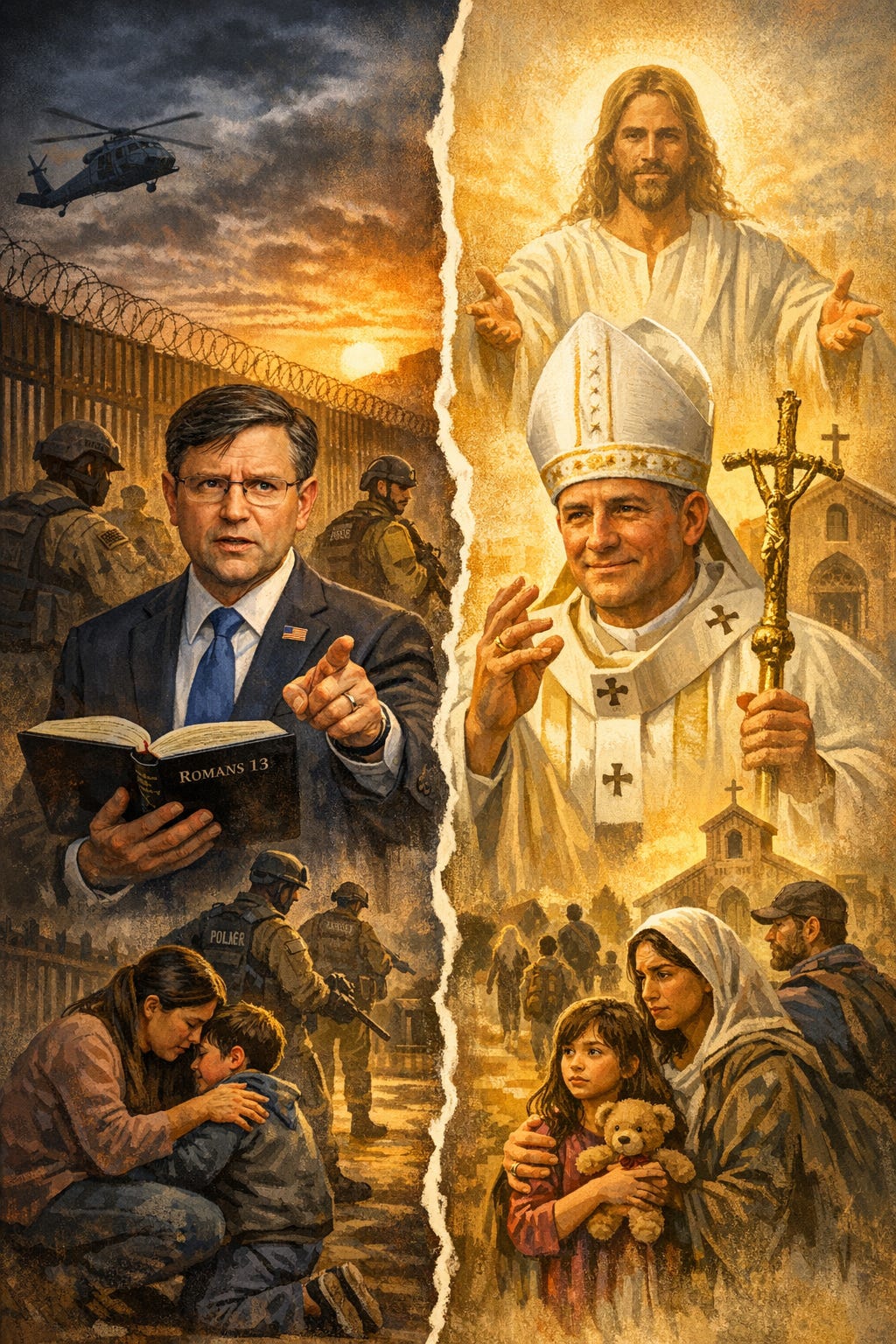
On Tuesday, Speaker Mike Johnson stood in a Capitol hallway and did something extraordinary: he attempted to correct the Pope on what the Bible says about immigration.
Not just any pope. Pope Leo XIV—the first American-born pontiff, the former missionary who spent twenty years in Peru, the man who has made Matthew 25:35 his North Star on the treatment of migrants. The pope who told reporters that Jesus “says very clearly at the end of the world, we’re going to be asked, you know, how did you receive the foreigner?”
And Mike Johnson—Southern Baptist, constitutional lawyer, Louisiana congressman—looked into the camera and said: Actually, your Holiness, let me give you a theological dissertation.
What followed was not a dissertation. It was a masterclass in how to use Scripture to baptize cruelty, how to construct a hermetically sealed interpretive system that allows you to support family separation while quoting Leviticus, and how to perform theology so transparently political that even the performance itself becomes the point.
Pope Leo cited Matthew 25. Johnson cited Romans 13. And in the space between those two passages lies a chasm that reveals everything about how American Christianity has learned to make peace with power.
This is the autopsy of that argument. Not the political argument—Johnson can hold whatever immigration policy views he wants. This is an autopsy of the theological claim, the scriptural scaffolding, the hermeneutical gymnastics required to look at the Bible’s repeated, emphatic, non-negotiable commands to protect the stranger and say: Actually, that only applies to individuals, not governments.
Let’s get surgical.
“So You Want Me to Give You a Theological Dissertation?”
The reporter’s question was direct: “Pope Leo has cited Matthew 25:35 to critique Donald Trump’s mass deportation agenda. How would you respond to Pope Leo in scripture?”
Johnson’s response dripped with condescension: “So you want me to give you a theological dissertation? All right. I tell you what. I’ll post it on my website later today, but let me give you a quick summary.”
And then he launched. Borders are biblical. Walls are biblical. Assimilation is expected. Civil authorities have a mandate to maintain order. Romans 13 says so. The stranger commands apply to individuals, not governments.
Later that day, Johnson posted a 1,300-word essay to X—the same one you’ve already read—expanding his hallway talking points into a full-throated defense of immigration enforcement as divine mandate.
The structure of the argument is brilliant in its circularity. Johnson begins by claiming that “context is critical,” then proceeds to strip every single command about the treatment of strangers from its communal and political context, relocate those commands to the private sphere, and elevate a single passage about governmental authority into a principle that overrides everything else.
He is technically citing Scripture. But he is not doing exegesis. He is doing apologetics for state violence, and he is using the Bible to give that violence the appearance of divine sanction.
The Four-Sphere Shell Game
The hinge of Johnson’s entire argument is a theological framework most of his audience won’t recognize: the doctrine of “sphere sovereignty,” which holds that God has ordained four distinct spheres of authority—individual, family, church, and civil government—each with separate responsibilities.
Johnson writes:
“The Bible teaches that God ordained and created four distinct spheres of authority… and each of these spheres is given different responsibilities.”
This is presented as if it were plain biblical fact. It is not. It is a Reformed theological construct developed in 19th-century Europe by Abraham Kuyper. It is one interpretive tradition among many, and it functions in Johnson’s argument as a sorting mechanism: mercy goes to individuals, enforcement goes to the state.
Here’s the move: if you can convince your audience that God has divided the world into hermetically sealed zones of responsibility, then you can assign every uncomfortable verse to the wrong zone. Commands to love the stranger? That’s for individuals. Commands to care for the vulnerable? That’s for the church. Commands to do justice? Well, that’s what Romans 13 enforcement is.
The problem is that the Bible itself does not recognize these boundaries. The Hebrew prophets condemn kings for oppressing the stranger. The Torah’s laws governing treatment of the ger (sojourner) were directed at the community as a political entity—Israel as a nation, not Israel as a collection of private citizens. When Amos thunders “Let justice roll down like waters,” he is not addressing individual piety. He is indicting systems of power.
Jesus himself spends a significant portion of the Gospels confronting political and religious authorities over how they wield power. The Sermon on the Mount is not a manual for private virtue—it is a public teaching delivered to crowds, challenging the dominant systems of honor, violence, and purity that structured first-century Jewish society.
Johnson’s framework allows him to pre-sort every verse before he even opens the text. And once the sorting is done, the conclusion is inevitable.
Romans 13 as a Blank Check
Let’s talk about Romans 13, since Johnson treats it as the trump card that overrides every other biblical command.
Paul writes that governing authorities are established by God, that they do not bear the sword in vain, and that they are “God’s servant, an agent of wrath to bring punishment on the wrongdoer.”
Johnson takes this passage and extracts from it a principle: civil authorities are mandated to enforce law, and immigration enforcement is law enforcement, therefore immigration raids carry divine authorization.
But here’s what Romans 13 does not say:
It does not say that every law a government passes is morally righteous.
It does not say that every exercise of state power is beyond critique.
It does not say that Christians should support all governmental actions simply because governments exist.
Paul wrote Romans 13 to a Christian community living under Roman imperial rule—a regime that crucified Jesus, that would soon burn Christians as torches in Nero’s gardens, that Paul himself would eventually die under. The passage is not a treatise on ideal government. It is pastoral guidance on how to survive and bear witness in a context of occupation and imperial violence.
And here’s the thing: Paul himself defied Roman authorities when their commands conflicted with his mission. Peter told the Sanhedrin, “We must obey God rather than human beings.” The same apostles who acknowledged the reality of governmental power also challenged, resisted, and suffered under it when it acted unjustly.
Johnson wants Romans 13 to mean: governments have authority, therefore what they do is right.
But the text says: governments have authority, and Christians must navigate that reality with wisdom—discerning when to submit, when to resist, and when to suffer the consequences of resistance.
Treating Romans 13 as a blank check for state enforcement is not biblical interpretation. It is ideological convenience dressed up as theology.
“Borders Are Biblical” (No, They’re Not)
Johnson argues that borders and walls are biblically endorsed because the Bible mentions nations, boundaries, and—his favorite example—Nehemiah rebuilding the walls of Jerusalem.
This is category confusion disguised as exegesis.
Yes, the Bible describes the existence of nations. Yes, it mentions walls. But describing a thing is not the same as prescribing it. The Bible describes slavery, monarchy, and polygamy. That does not make them divine mandates.
Nehemiah rebuilt the walls of Jerusalem after they were destroyed by invading armies. He was reconstructing defensive infrastructure for a traumatized, returning exile community. He was not building an immigration checkpoint. He was not conducting raids. He was protecting a vulnerable population from military threats.
To take Nehemiah’s post-exile reconstruction and transfer it onto 21st-century immigration policy is hermeneutical malpractice. It is to treat ancient narrative as universal blueprint, stripping it of historical context and forcing it to bear ideological weight it was never designed to carry.
And here’s the theological irony: the Israelites rebuilding Jerusalem in Nehemiah were themselves returning migrants. They were the refugees coming home after decades of forced displacement. If there’s a lesson in Nehemiah about immigration, it’s not about keeping people out—it’s about how vulnerable populations rebuild in the aftermath of violence.
But Johnson doesn’t read Nehemiah as a story about displaced people finding home. He reads it as a story about walls, and he uses those walls to justify raids.
What’s Missing: The Entire Prophetic Tradition
Here’s what Johnson does not cite:
Exodus 22:21: “Do not mistreat or oppress a foreigner, for you were foreigners in Egypt.”
Deuteronomy 10:18-19: “He defends the cause of the fatherless and the widow, and loves the foreigner residing among you, giving them food and clothing. And you are to love those who are foreigners, for you yourselves were foreigners in Egypt.”
Jeremiah 7:5-7: “If you do not oppress the foreigner, the fatherless or the widow… then I will let you live in this place.”
Ezekiel 22:29: “The people of the land practice extortion and commit robbery; they oppress the poor and needy and mistreat the foreigner, denying them justice.”
Zechariah 7:9-10: “Administer true justice; show mercy and compassion to one another. Do not oppress the widow or the fatherless, the foreigner or the poor.”
Matthew 25:35-40: “I was a stranger and you invited me in… Truly I tell you, whatever you did for one of the least of these brothers and sisters of mine, you did for me.”
These passages are not quoted. They are not dismissed. They are simply absent.
And their absence is structural, not accidental. Johnson’s interpretive framework has no place for them. If mercy is private and enforcement is governmental, then these passages—which explicitly tie God’s favor and moral judgment to how communities and rulers treat the vulnerable—become unreadable. They don’t fit the system.
So they disappear.
The Pope’s Actual Argument
Let’s be clear about what Pope Leo XIV has actually said, because it’s worth contrasting with Johnson’s caricature.
Leo has not argued for “open borders.” He has not called for the abolition of immigration law. He has not said that nations cannot regulate entry.
What he has said—repeatedly, consistently, in language drawn directly from Matthew 25—is that how a society treats migrants is a measure of its moral standing before God.
He has said that people who have lived in the United States for 10, 15, 20 years without incident deserve to be treated with dignity, not rounded up in raids that separate families and traumatize children.
He has said that detained migrants have spiritual rights—that they should have access to pastoral care, to the sacraments, to the presence of their faith community.
He has said that when ICE agents block priests from bringing communion to detainees, something is deeply wrong.
And he has said that at the final judgment, Christians will be asked: “How did you receive the foreigner?”
This is not a policy prescription. This is a theological claim about the nature of discipleship. It is a claim grounded in the text Johnson says he reveres—Matthew 25, where Jesus identifies himself with the hungry, the thirsty, the stranger, the imprisoned, and declares that how we treat them is how we treat him.
Johnson’s response to this is to say: that command is for individuals, not governments.
But Matthew 25 is part of a discourse on the judgment of nations. The Greek word is ethne—peoples, nations, communities. The judgment Jesus describes is not about private charity. It is about collective responsibility. It is about how societies, as societies, care for the vulnerable.
Johnson has to make Matthew 25 private in order to neutralize it. But the text will not allow that move.
The Assimilation Cudgel
Here’s a new piece of theological innovation Johnson introduced in the hallway:
“What’s also important in the Bible is that assimilation is expected and anticipated and proper. When someone comes into your country, comes into your nation, they do not have the right to change its laws or to change a society. They’re expected to assimilate. We haven’t had a lot of that going on.”
Where, exactly, does the Bible teach this?
Johnson doesn’t say. He can’t, because there’s no verse that says “immigrants must assimilate to the host culture and are forbidden from changing laws.”
What the Bible does say is that the ger—the sojourner, the resident alien—was subject to the community’s laws but also entitled to its protections. The ger participated in religious observances, shared in the harvest gleanings, and was included in the justice system. There was integration, yes, but not on pain of exclusion. The community was commanded to expand to include the stranger, not to demand the stranger conform or leave.
Johnson’s assimilation language is not drawn from Scripture. It’s drawn from 20th-century American nativism, the rhetoric of “Americanization” that sought to strip immigrants of their language, culture, and identity in order to make them acceptable.
And he’s smuggling it into the biblical text as if it were there all along.
The Real Function of This Argument
Let’s step back and name what’s actually happening here.
Mike Johnson is not doing biblical exegesis. He is performing political theology—using sacred text to manufacture divine authorization for a policy agenda.
The function of his argument is not to illuminate Scripture. It is to foreclose debate. Once you’ve claimed that “the Bible tells us” immigration enforcement is righteous, you’ve turned a policy question into a theological mandate. Resistance becomes not just political disagreement, but disobedience to God.
This is how power has always used Scripture. Selectively. Strategically. With just enough citation to give the appearance of authority.
The history of Christianity is littered with examples: the Bible was used to justify slavery, colonization, segregation, the subjugation of women, the persecution of Jews. Always with verses. Always with interpretive frameworks. Always with the claim that God’s word demanded it.
And always, in retrospect, we look back and see the interpretive violence—the way the text was bent, stripped of context, forced to carry ideological weight it could not bear.
Johnson is doing the same thing. He is taking a collection of ancient texts written in radically different contexts—covenant law for a theocratic nation, pastoral letters to early Christian communities under imperial occupation, prophetic denunciations of unjust rulers—and hammering them into a coherent defense of 21st-century immigration raids.
It doesn’t work. The seams show. The categories don’t fit. The omissions are too glaring.
But it sounds authoritative. It uses the right words. It cites chapter and verse. And for an audience that doesn’t know how to read Scripture critically, it might even be persuasive.
The Pope Knows Better
Here’s the thing: Pope Leo XIV knows this game. He grew up in the United States. He knows American evangelicalism. He spent two decades doing missionary work in Peru, navigating the intersection of faith, poverty, migration, and power.
And he knows that when Jesus says “I was a stranger and you invited me in,” he is not offering a policy recommendation. He is identifying himself with the most vulnerable, and declaring that how we treat them is how we treat him.
You cannot sphere-sovereignty your way out of that claim. You cannot relocate it to private charity and exempt the state. Because the passage is about judgment—collective judgment, communal judgment, the judgment of how societies order themselves and who they protect.
Leo has been unequivocal: people who have lived peacefully in the United States for years, who have built lives and raised families, who have harmed no one—treating them “in a way that is extremely disrespectful, to say the least,” is morally unacceptable.
He has called on American bishops to be “more forceful” in resisting policies that traumatize the vulnerable. He has praised their pastoral letter, which states clearly: “The priority of the Lord, as the Prophets remind us, is for those who are most vulnerable: the widow, the orphan, the poor, and the stranger.”
And he has urged “deep reflection” on what is happening—because he knows that when Christians participate in systems that terrorize immigrant communities, they are betraying the Gospel they claim to follow.
Johnson’s response to this is to cite Romans 13 and claim that enforcement is righteousness.
But Leo is citing the entire biblical witness—the prophets, the Gospels, the epistles that command care for the vulnerable—and asking: how will you answer when you stand before the One who said, “I was a stranger”?
The Moral Escape Hatch
Johnson’s framework creates a convenient escape: individuals should be merciful, but governments must enforce. This allows the state to act without moral accountability. As long as mercy stays private and enforcement stays public, the system can separate families, traumatize children, and conduct raids—all while claiming biblical sanction.
But the Bible does not offer this escape. Throughout Scripture, rulers are judged by how they treat the vulnerable. Kings are condemned for neglecting justice. Systems of power that grind down the poor and the stranger come under prophetic indictment. Jesus announces that the powerful will be brought low and the lowly lifted up.
There is no sphere of power that is exempt from the command to do justice and love mercy. Governments do not get a moral pass just because they exist.
And Christians who support unjust policies cannot hide behind Romans 13 and claim they’re only following orders.
Final Judgment
Mike Johnson wrote 1,300 words claiming that “the Bible tells us” to support immigration enforcement and border raids.
Pope Leo XIV cited Matthew 25 and asked a single question: “How did you receive the foreigner?”
One of these is theology. The other is apologetics for power.
Johnson’s argument is internally coherent only if you accept his unstated premises: that sphere sovereignty is biblical, that Romans 13 outweighs everything else, that ancient texts about covenant communities transfer seamlessly onto modern nation-states, that mercy is private and enforcement is public, that the Bible’s commands to protect the stranger don’t apply to governments.
But none of those premises can be sustained by the text itself. They are imported, imposed, designed to produce a predetermined conclusion.
The Bible Johnson claims to revere tells a different story. It tells the story of a God who commands protection of the stranger not because they are legal, but because they are vulnerable. Who judges communities—and their leaders—by how they treat those with the least power. Who declares through the prophets that justice toward the marginalized is not optional but central to faithfulness. Who says, through Jesus, that neglecting the stranger is neglecting him.
Pope Leo knows that story. He has spent his life living it—among the poor in Peru, among the displaced, among those whom systems of power crush and discard.
Mike Johnson knows a different story. He knows the story where Scripture can be sorted, where mercy can be outsourced, where the state can act without moral constraint as long as it invokes Romans 13.
When the Pope cites Matthew 25, he is asking: At the final judgment, when you are asked how you treated the stranger, what will you say?
When Johnson cites Romans 13, he is saying: I was following the law.
One of these answers might satisfy a congressional hearing. But it will not satisfy the One who said, “I was a stranger, and you did not welcome me.”
The Pope knows that. The Bible knows that. And no amount of theological gymnastics can change it.